

PRESS RELEASE – 2026 ABSA TOP 10 WINNERS
28 August 2026
THIRTY COMPETITIONS. 300 WINNING WINES. THE ABSA TOP 10 PINOTAGE MARKS THREE DECADES OF SOUTH AFRICAN EXCELLENCE
The 2026 Absa Top 10 Pinotage winners bring together established champions, returning names and wines from six different Wine of Origin areas as South Africa’s own grape enters its next era.
RAWSONVILLE, 27 AUGUST 2026 — Thirty competitions. Three hundred Top 10 wines. Three decades in which vineyards, winemakers and producers have continually raised the standard for South Africa’s own grape. The announcement of the 2026 Absa Top 10 Pinotage winners at La Valle in Rawsonville today carries significance well beyond the ten wines receiving the year’s honours.
It marks the 30th Absa Top 10 Pinotage Competition and brings the number of wines to have received a Top 10 place since the competition began in 1997 to exactly 300.
The milestone offers a rare opportunity to look both ways: at what 29 completed competitions tell us about the development of Pinotage, and at what the ten wines selected in 2026 suggest about the people, places and vineyards that will carry it forward.
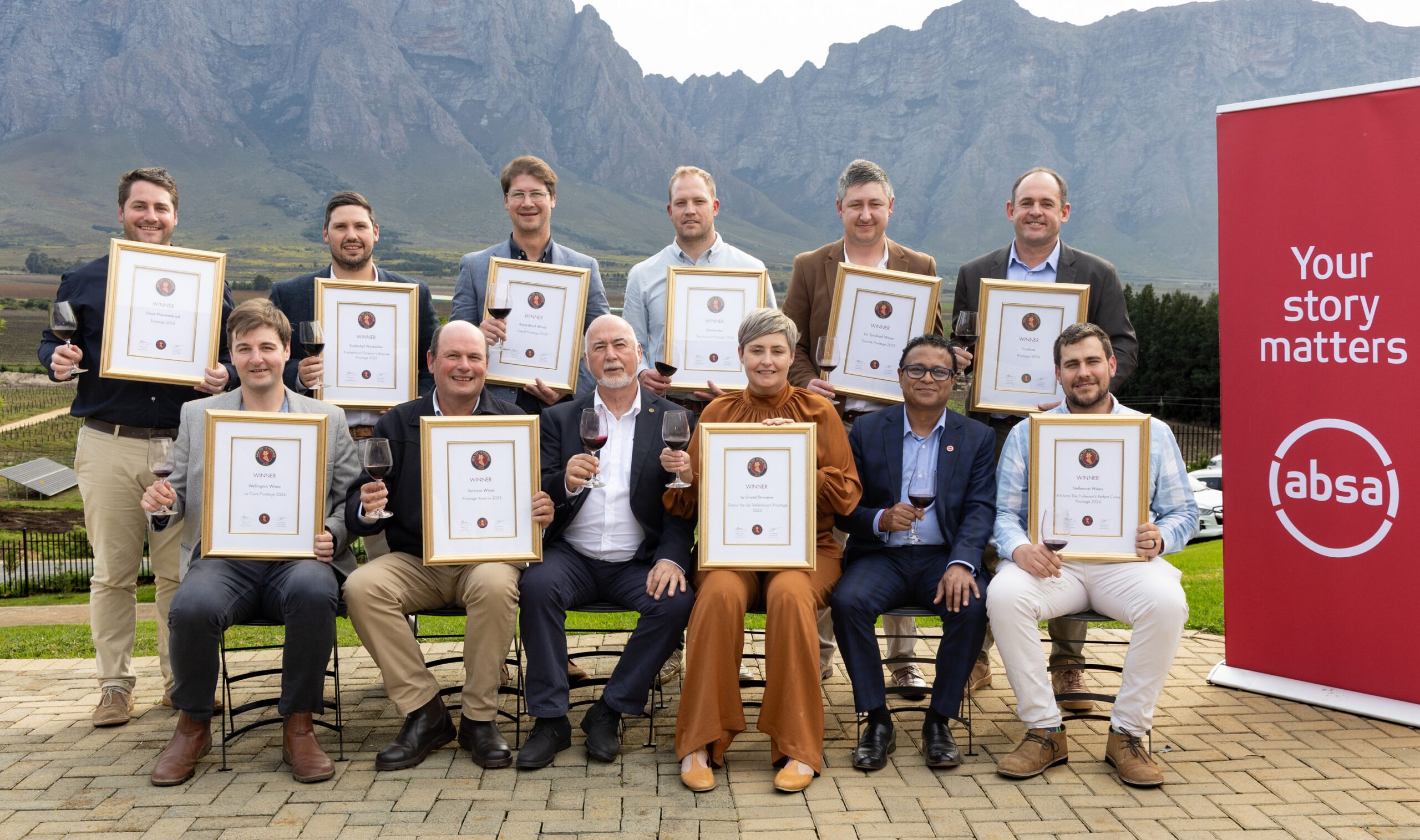
The 2026 Absa Top 10 winners are:
Diemersdal – Diemersdal The Journal Pinotage 2024, WO Durbanville
Survivor Wines – Survivor Pinotage Reserve 2023, WO Swartland
Beyerskloof Wines – Beyerskloof Diesel Pinotage 2022, WO Stellenbosch
Du Toitskloof Wines – Du Toitskloof Granite Pinotage 2025, WO Malmesbury
Koelenhof Wynkelder – Koelenbosch Director’s Reserve Pinotage 2023, WO Stellenbosch
Wellington Wines – Wellington Wines La Cave Pinotage 2024, WO Wellington
Stellenrust Wines – Stellenrust ArtiSons The Professor’s Perfect Crime Pinotage 2024, WO Stellenbosch
Langdam FrostLine – Frostline Pinotage 2024, WO Koo Plateau
Groot Phesantekraal – Groot Phesantekraal Pinotage 2024, WO Durbanville
Le Grand Domaine – Le Grand Domaine Grand Vin de Stellenbosch Pinotage 2024, WO Stellenbosch
They emerged from 112 entries submitted by 59 producers in 2026. The judging panel comprised Etienne Louw, panel convener; Wynand Lategan; Lucinda Heyns; Kiara Scott; and Moses Magwaza.
The twenty finalists who reached the final stage of the competition are also part of this celebration. Reaching the Top 20 represented progression through a highly competitive field; today’s announcement identifies the ten wines that will now carry the Absa Top 10 distinction for 2026.
A partnership measured in decades
The story of the Absa Top 10 is inseparable from the relationship between Absa and the Pinotage Association. Chairman of the Pinotage Association Beyers Truter has often recounted the beginnings of that relationship to the wine industry: a young organisation with large ambitions, very limited means and a chairman who, as he tells it, had quite literally worn holes into the trousers of his only dress suit.
Truter approached then Absa chief executive Nallie Bosman, and recalls the first sponsorship being in the region of R30 000.00
What followed became far more consequential than a once-off sponsorship.
The competition established an annual benchmark around Pinotage. Winning producers received a platform for recognition and promotion. Results accumulated. Standards could be compared from year to year. Producers had reason to measure their wines against the best examples being made elsewhere in the country.
Over time, Absa’s involvement with the Pinotage Association expanded across initiatives recognising not only flagship Pinotage, but the grape’s ability to mature, its role in distinctively South African Cape Blends and its expression as rosé.
That continuity matters.
Wine development does not take place over a season. Vineyards mature over years. Winemakers learn through successive vintages. Markets and reputations are built over decades.
A corporate partnership sustained across that period has given Pinotage something particularly valuable: time.
The Pinotage Association therefore records its sincere gratitude to Absa for 30 competitions of partnership, belief and support.
Thank you for backing Pinotage when much of its modern story was still unwritten; for supporting the producers and people prepared to improve it; and for remaining part of the conversation as the variety has moved from proving its potential to defining what excellence can look like.
The milestone belongs to the winners, but it also belongs to a partnership that stayed the course.
What 29 completed competitions tell us
The historical record from 1997 to 2025, deliberately excluding the 2026 winners, provides a substantial body of evidence about competitive Pinotage in South Africa.
Across those 29 completed competitions, 290 wines received Top 10 honours. At the head of the all-time producer ranking is Kanonkop with 17 Top 10 trophies, the highest total achieved by a producer in the competition between 1997 and 2025. It is followed by Beyerskloof with 15, Rijk’s with 14, Diemersdal with 12, and Flagstone, L’Avenir and Windmeul with 10 each. Those seven producer identities account for 88 of the 290 Top 10 places awarded between 1997 and 2025. The record also contains achievements that say much about sustained performance. Beyerskloof also holds the competition record for the longest consecutive winning-year streak: eight years.
Consistency, however, tells only part of the story.
One of the most important findings in the historical data is that the door has continued to open. As recently as 2025, Alvi’s Drift, Bruce Jack Wines, Le Grand Domaine and Warwick became first-time Top 10 winners. After 29 competitions, four new producer names were still able to enter the winner record in a single year. And one of them, Le Grand Domaine, has returned to the Top 10 again in 2026.
That is an important characteristic of a credible competition: history carries weight, but history does not reserve tomorrow’s places.
Stellenbosch remains powerful. The map no longer ends there. Historically, Stellenbosch has remained the heartland of Top 10 Pinotage, but the winning map has broadened substantially over the years. The 2026 result makes that geographic breadth particularly visible. Four of this year’s winning wines carry Stellenbosch origin, two are from Durbanville, with one each from the Swartland, Malmesbury, Wellington and Koo Plateau. Six Wine of Origin areas are therefore represented among only ten winning wines. The FrostLine Pinotage from the Koo Plateau is especially illustrative of how widely the search for distinctive Pinotage is now reaching. Alongside it sit wines from long-established Pinotage territories and producers with substantial competition histories.
This does not diminish the significance of traditional strongholds. It strengthens the broader story. Pinotage is demonstrating that South African regionality need not mean one region, one interpretation or one stylistic formula.
Why Pinotage carries South African pride
Pinotage occupies an unusual place in South African wine because its history did not begin elsewhere. It was created here.
Professor Abraham Izak Perold crossed Pinot Noir and Cinsaut, then commonly known locally as Hermitage, and planted the resulting seeds in Stellenbosch in 1925. From those beginnings came a variety now inseparable from South African wine history. That gives Pinotage a significance beyond what is in the bottle.
It represents South African agricultural knowledge, experimentation and persistence. Its history includes near-loss, recovery, commercial planting, periods of criticism, renewed technical understanding and, ultimately, producers capable of making wines that compete at the highest levels of the industry. Its South African identity is therefore not a marketing construct applied afterwards. It is part of the variety’s origin. Perhaps that is why Pinotage can carry pride without requiring uniformity. Stellenbosch does not have to taste like the Swartland. Durbanville does not have to replicate Wellington. A wine from the Koo Plateau does not need to imitate any of them. The shared identity is Pinotage. The difference is place.
Innovation begins in the vineyard
The evolution of Pinotage is also increasingly tied to work taking place before grapes reach a cellar.
One example is the preservation and propagation work undertaken at Meerendal’s historic 1955 Pinotage Heritage Block in collaboration with Vititec. Material selected from the old vineyard underwent treatment and virus-cleaning processes as part of a long-term programme to preserve valuable vine material for future plantings. It is an instructive example of what innovation in wine can mean. Sometimes progress is not about replacing what came before. Sometimes it is about understanding what deserves to be preserved, applying modern viticultural science to it, and ensuring that the next generation receives healthier plant material carrying an important genetic link to the past.
That intersection — heritage, research, vineyard science and practical application — will become increasingly important as Pinotage enters its second century. The 2026 winners and the generation that follows. No competition result can predict the future of a grape variety. But it can show us where work of a high standard is being done now.
The 2026 Top 10 provides several useful signals.
The winning wines span four vintages, from 2022 to 2025. Six of the ten are from the 2024 vintage. Two are from 2023, while 2022 and 2025 are each represented once. They come from six different Wine of Origin areas. Long-established competition names including Beyerskloof and Diemersdal stand beside a wider group of producers representing different histories, scales of operation, vineyards and winemaking environments. And Le Grand Domaine, which entered the historical Top 10 record for the first time only in 2025, has returned immediately in 2026.
The next era of Pinotage therefore does not appear to require the old guard to make way for the new. There is room for both. That may ultimately be one of the most valuable legacies of the Absa Top 10: young winemakers do not inherit an empty page. They inherit three decades of benchmarks, mistakes, research, vineyard knowledge and proven examples.
Their task is not simply to repeat them. It is to understand them well enough to decide what comes next. The producers and winemakers recognised in 2026 now become part of that record — and part of the reference point against which future Pinotages will be considered.
Absa Top 10 Pinotage by the numbers: 1997–2026
30 — Absa Top 10 Pinotage competitions
300 — Top 10 winning wines across those 30 competitions
17 — Kanonkop Top 10 trophies; the all-time producer leader
16 — Beyerskloof Top 10 trophies following its 2026 win
14 — Rijk’s Top 10 trophies
13 — Diemersdal Top 10 trophies following its 2026 win
10 each — Flagstone, L’Avenir and Windmeul trophies through 2025
112 — wines entered in the 2026 competition
59 — producers represented in the 2026 entries
6 — Wine of Origin areas represented among the 2026 Top 10
4 — Stellenbosch wines in the 2026 Top 10
2 — Durbanville wines in the 2026 Top 10
1 each — winning wines from Swartland, Malmesbury, Wellington and the Koo Plateau
4 — vintages represented among the 2026 winners: 2022, 2023, 2024 and 2025
1 — South African grape variety at the centre of it all.
Pinotage.
A milestone worth celebrating
There are moments when numbers become more than statistics. 300 wines across 30 competitions represents hundreds of vineyard decisions, harvests, fermentations, blending decisions and bottles submitted for judgement.It represents producers who returned after winning and producers who returned after not winning. It represents established names that helped create the reputation of Pinotage and new names prepared to challenge them. And behind it is a partnership that began when the future of Pinotage looked very different from the position it holds today.
“The 30th Absa Top 10 is much more than another awards announcement. It is a moment to celebrate the ten wines and winemakers who join the Top 10 this year, but also to recognise every producer, winemaker, viticulturist, vineyard worker and cellar team who has contributed to this competition since 1997. Many of the people behind these wines will never have their names engraved on a trophy, but their work is in every bottle.
And above all, this milestone gives us an opportunity to say thank you to Absa. Thirty years is an extraordinary partnership. Thank you for believing in Pinotage, for helping us build a competition that has continually challenged us to improve the quality and standing of South Africa’s own grape, and for continuing to invest in the people who will shape its future. We started this journey together 30 competitions ago; today we celebrate 300 Top 10 wines, and I believe the most exciting chapters of Pinotage are still ahead of us.” Beyers Truter, Chairman, Pinotage Association
The first 30 competitions have given South African wine 300 Absa Top 10 Pinotages. The next number has not yet been written. That belongs to the vineyards, winemakers and producers who come next. And that is something worth raising a glass to.
— ENDS —
PHOTO CAPTION
Back left to right: Richard Schroeder, Handré Visagie, Anri Truter, Juandre Bruwer, Tiaan Loubser, Stephen Joubert.
Front left to right: Daniel Slabber, Bussel Rietief, Beyers Truter, Debbie Thompson, Anand Naidoo, Herman Du Preez
About the Absa Top 10 Pinotage Competition
Organised by the Pinotage Association, the annual Absa Top 10 Pinotage Competition identifies ten wines to serve as benchmarks for the development and promotion of distinctive South African Pinotage and to demonstrate the uniqueness of the variety in the local and international wine landscape.
About the Pinotage Association
The Pinotage Association works to develop the quality of Pinotage through knowledge exchange, viticultural and winemaking education, identification of production challenges, research priorities and the promotion of South Africa’s own grape variety.
Visit pinotage.co.za | Contact brand@pinotage.co.za
